
The Real Store Renovation ROI: When Should You Refresh a Branch?
Retail performance rarely declines overnight.
Instead, it shifts gradually—often in ways that are difficult to detect at first. A store continues to operate, customers still visit, and sales remain relatively stable. On the surface, nothing appears urgent.
But over time, subtle inefficiencies begin to accumulate.
Customers move through the space differently than before. Certain product areas receive less attention. High-margin items no longer stand out as they once did. These small changes, repeated daily, begin to affect overall performance.
This is where the concept of store renovation ROI becomes critical.
Because the decision to renovate a retail branch should not be driven by how the space looks—it should be driven by how the space performs.
Understanding the Real Meaning of Store Renovation ROI
Store renovation ROI is often misunderstood.
For many brands, renovation is viewed as a cost tied to visual upgrades—new finishes, updated lighting, or refreshed branding. While these elements influence perception, they are not what ultimately drive return.
The real ROI of a store renovation comes from improving how the space supports customer behavior.
A well-executed renovation does not just make a store look better. It makes it function better. It improves how customers navigate the space, how products are discovered, and how purchasing decisions are made.
When this alignment is achieved, the impact becomes measurable.
Retail environments that undergo strategic renovation typically achieve:
- 8% to 15% increase in sales per square meter
- Improved dwell time and product engagement
- Higher average basket size
These outcomes are not the result of aesthetic changes alone. They are the result of correcting spatial inefficiencies that were limiting performance.
Why Store Performance Declines Before It Looks Outdated
One of the biggest challenges in retail is that performance decline is not always visible.
A store may still appear modern and well-maintained, yet no longer operate efficiently. This happens because customer behavior evolves faster than physical spaces.
As shopping patterns change, layouts that once worked begin to lose effectiveness. Circulation paths no longer match how customers move. Product adjacencies no longer reflect purchasing behavior. Visibility of key items becomes inconsistent.
Over time, this misalignment leads to:
- Reduced exposure to high-value products
- Uneven customer flow across the store
- Lower engagement with certain categories
In measurable terms, this often results in a 5% to 12% decline in sales per m²—a gradual loss that is easy to overlook but significant over time.
By the time visual signs of aging appear, the financial impact has already taken place.
When Should You Refresh a Retail Branch?
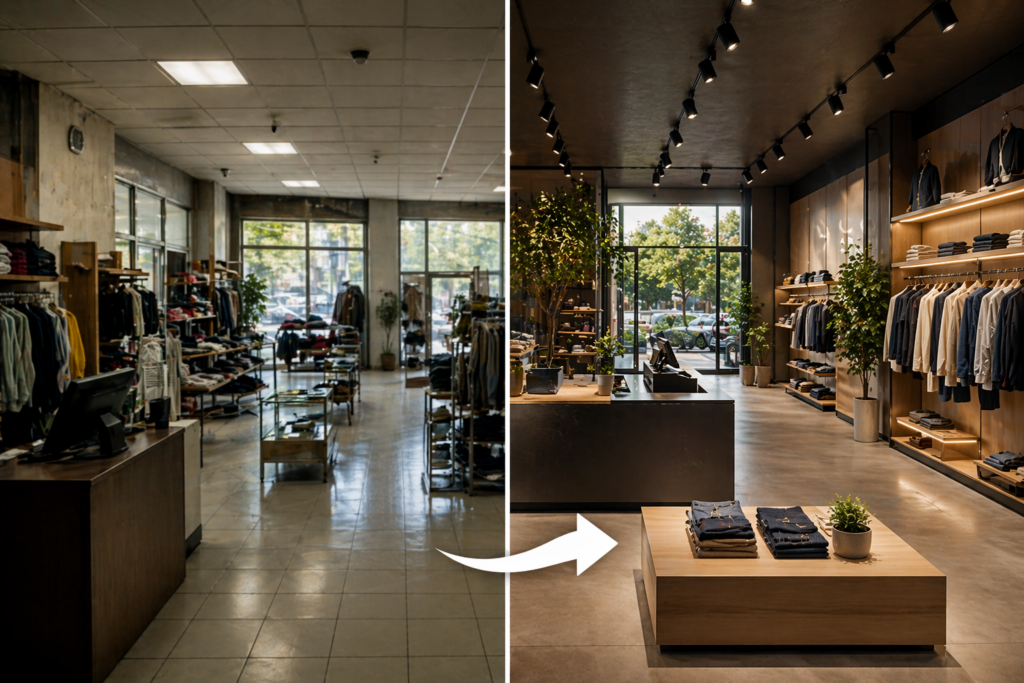
The timing of a branch refresh is one of the most important factors in achieving strong store renovation ROI.
Renovating too late means absorbing ongoing performance loss. Renovating without clear signals can limit return.
The most effective approach is to base the decision on performance indicators.
One of the earliest signals is a consistent drop in sales per square meter. When external factors such as location or pricing remain stable, this decline often points to spatial inefficiencies within the store.
Another indicator is a shift in customer movement. If certain areas are consistently underused or bypassed, it suggests that the layout is no longer guiding customers effectively.
Changes in product strategy also play a major role. When new categories are introduced or priorities shift, the existing layout may no longer support these changes. Without adaptation, the store continues to reflect outdated business logic.
Operational inefficiencies provide further insight. Congestion in key areas, difficulty in restocking, or inefficiencies at checkout all indicate that the space is no longer functioning optimally.
In competitive markets, external pressure is also a trigger. When nearby stores improve their layouts and customer experience, expectations change—even if your store has not.
Recognizing these signals early allows brands to act at the right moment, maximizing the return on renovation.
What Drives High Store Renovation ROI
Not all renovations deliver meaningful results.
The difference lies in whether the renovation is visual or strategic.
High ROI comes from changes that directly impact how customers interact with the space.
One of the most critical elements is circulation. When movement through the store is intuitive and well-guided, customers are more likely to explore multiple zones, increasing exposure to products.
Visibility plays an equally important role. Products that are not clearly visible are rarely considered. Adjusting sightlines and display hierarchy can significantly improve engagement without changing inventory.
Adjacency—the relationship between product categories—also influences purchasing behavior. When complementary items are placed together, they encourage additional purchases and increase basket size.
The checkout area, often overlooked, is another key contributor. A well-designed checkout zone reduces friction and creates opportunities for impulse purchases at the final stage of the journey.
These factors work together to transform the store into an environment that actively supports revenue generation.
Renovation as a Strategic Business Decision
The most important shift is not in design—it is in mindset.
Retail renovation should not be treated as a periodic upgrade. It should be treated as a business strategy tied to performance metrics.
This means that renovation decisions are based on:
- Sales performance
- Customer behavior
- Space utilization
- Operational efficiency
Rather than reacting to visual decline, organizations proactively identify when their space is no longer aligned with their business goals.
This approach allows them to maintain consistent performance across locations and avoid long periods of underperformance.
Moving from One-Time Renovation to Continuous Optimization
High-performing retail brands do not approach renovation as a one-time event.
They treat it as part of an ongoing cycle:
- Monitor performance
- Identify inefficiencies
- Implement targeted upgrades
- Measure impact
This continuous approach ensures that stores remain aligned with evolving customer expectations and business strategies.
For multi-branch retailers, this is especially important. Improvements in one location can be standardized and applied across the network, amplifying overall ROI.
Why Store Renovation ROI Matters in Egypt’s Retail Market
In Egypt’s retail environment, brands are operating under increasing pressure.
Competition is growing. Customer expectations are rising. Operational costs continue to increase.
Under these conditions, every store must perform at its highest potential.
A branch that is not optimized is not just underperforming—it is limiting revenue and reducing competitiveness.
Strategic renovation provides a way to unlock value without expanding footprint. It allows brands to improve performance using the space they already have.
Conclusion: Renovation Is About Performance, Not Appearance
The real ROI of store renovations is not measured in how a space looks after the upgrade.
It is measured in how the space performs.
A well-timed branch refresh can increase sales, improve customer flow, and enhance overall efficiency. But these results only happen when renovation is approached strategically.
The key is to recognize that performance decline often begins before visual decline—and to act based on data, not perception.
When this happens, renovation becomes more than an upgrade.
It becomes a driver of sustained retail growth.
At Comet Architects + Interiors, we approach store renovation as a performance strategy—not a visual upgrade.
We help retail brands:
- Identify underperforming branches
- Optimize layouts for higher revenue
- Execute renovations with minimal disruption
Visit cometarch.com to explore our approach to store renovation and retail performance.
Contact us to discover how strategic upgrades can improve sales per square meter and customer flow.