
5 Workplace KPIs to Measure Office Performance, Productivity, and Efficiency
In most organizations, performance is tracked with precision. Sales teams are measured by revenue. Operations are tracked through efficiency metrics. Marketing is evaluated through conversion and acquisition costs.
But when it comes to the workplace—the physical environment where all this performance happens—measurement is often missing.
Offices are designed, delivered, and occupied. Then they are assumed to be working.
The reality is more complex.
An office can be fully operational and still underperform. It can look efficient on the surface, yet quietly reduce productivity, slow collaboration, and increase operational friction. Without measurement, these issues remain invisible.
This is where workplace KPIs become critical.
They shift the conversation from “Do we like this office?” to
“Is this office improving how we work?”
The Gap Between Design and Performance
Most workplace decisions are still driven by assumptions.
An open office is expected to improve collaboration.
More meeting rooms are assumed to solve coordination issues.
A larger space is often seen as a solution to growth.
But in practice, these decisions do not always deliver the expected outcomes.
Open offices frequently increase noise and reduce focus.
Meeting rooms become overbooked regardless of how many are added.
Expanding space often introduces more inefficiencies instead of solving them.
The issue is not design itself—it is the absence of measurement.
Without clear workplace KPIs, there is no way to evaluate whether a design decision has actually improved performance or simply changed the environment.
What Workplace KPIs Actually Measure
Workplace KPIs translate space into performance indicators. They allow organizations to understand how effectively their office supports daily operations.
Rather than focusing on how a space looks, these metrics focus on how it behaves.
They reveal patterns such as:
- Where employees spend most of their time
- Which spaces are consistently underused
- How often teams are interrupted
- Whether collaboration is efficient or forced
- How the environment impacts employee experience
In this sense, workplace KPIs act as a diagnostic tool. They expose the gap between intended design and actual use.
The Core Indicators of a High-Performing Workplace
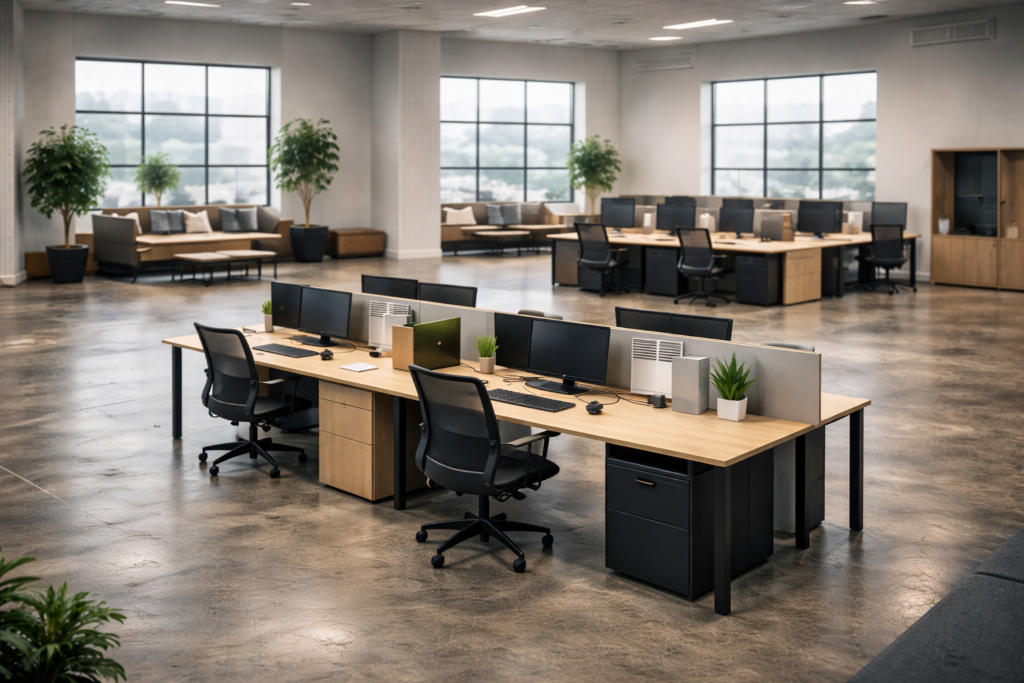
A high-performing office is not defined by a single metric. It is the result of multiple performance indicators working together. The most relevant KPIs tend to fall into four interconnected areas: productivity, utilization, collaboration, and experience.
Productivity: The Quality of Work Time
At the core of workplace performance is a simple question:
Does the environment help people focus?
In many offices, the answer is inconsistent.
Employees often shift between tasks that require deep concentration and tasks that involve interaction. When the environment does not support this shift—when quiet work happens in noisy areas or collaboration happens in unsuitable spaces—productivity declines.
Studies and workplace assessments show that improving spatial zoning and reducing distractions can increase focused work time by 15% to 25%.
This is not achieved by adding more desks or more space. It is achieved by aligning the environment with how work actually happens.
Utilization: The Reality of Space Use
One of the most revealing workplace KPIs is utilization.
It answers a fundamental question:
Are we using our space effectively?
In many offices, there is a clear imbalance. Some areas are constantly occupied, while others remain empty. Meeting rooms are fully booked, yet large sections of the office are rarely used.
This imbalance is not random—it is a result of layout decisions.
When space is planned strategically, organizations can improve utilization by up to 20%, often without expanding their footprint.
This has direct financial implications. It reduces the need for additional space, lowers operational costs, and increases the value extracted from existing real estate.
Collaboration: Speed and Efficiency, Not Frequency
Collaboration is often misunderstood as a quantity metric—more meetings, more interaction, more communication.
In reality, effective collaboration is about speed and clarity.
When teams are positioned far apart, or when appropriate collaboration spaces are unavailable, simple interactions become time-consuming. Employees rely on scheduled meetings for discussions that could have been resolved in minutes.
With improved adjacency and better spatial planning, organizations typically see a 10% to 18% improvement in coordination speed.
This is not because people collaborate more—it is because they collaborate more efficiently.
Experience: The Human Layer of Performance
Employee experience is often discussed in qualitative terms, but it is deeply connected to measurable outcomes.
A poorly performing workplace leads to:
- Constant interruptions
- Lack of comfort
- Difficulty finding suitable spaces
- Frustration with daily routines
Over time, this affects engagement, satisfaction, and retention.
When workplace design is aligned with user needs, organizations commonly report a 12% to 18% increase in employee satisfaction.
This is not just an HR metric. It has a direct impact on performance, continuity, and organizational stability.
From Measurement to Strategy
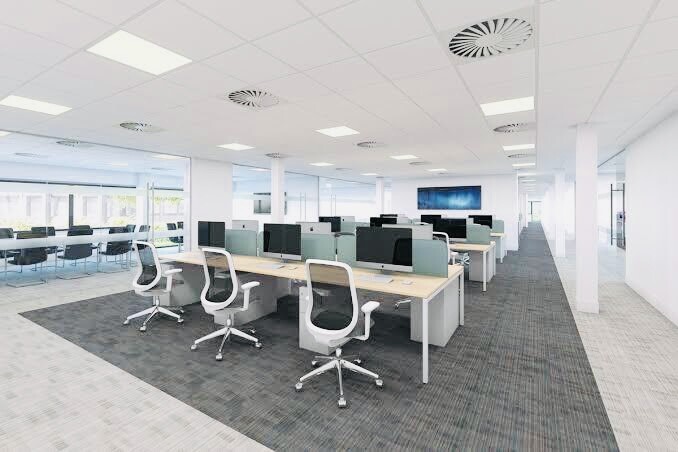
Understanding workplace KPIs is only the first step. The real value lies in how this data is used.
High-performing organizations treat workplace data as a strategic input, not just a report.
They use it to:
- Redefine spatial priorities
- Adjust layouts based on actual usage
- Improve adjacency between teams
- Introduce zoning that supports different work modes
This transforms workplace design from a static decision into an evolving system.
Why Most Offices Underperform Without Knowing It
One of the biggest challenges with workplace performance is that inefficiencies are normalized.
Employees adapt to their environment. They develop workarounds. They accept certain limitations as part of daily work.
As a result, organizations rarely question the effectiveness of their space.
An office may appear functional because work is getting done. But without measurement, there is no visibility into how much better it could perform.
This is where workplace KPIs create a shift. They make performance visible, measurable, and actionable.
The Egyptian Context: Efficiency Under Pressure
In Egypt’s corporate landscape, the importance of workplace performance is increasing.
Organizations are navigating:
- Rapid team growth
- Hybrid work adoption
- Rising real estate costs
- Increased competition for talent
Under these conditions, the workplace must do more with less.
It must support productivity without expanding space.
It must improve experience without increasing operational cost.
It must adapt quickly to changing business needs.
Without KPIs, these objectives are difficult to achieve.
With KPIs, the workplace becomes a controllable and optimizable asset.
Conclusion: Performance Starts With Measurement
A workplace that is not measured cannot be improved.
And a workplace that is not improved will eventually limit performance.
Workplace KPIs provide the clarity needed to understand how space contributes to business outcomes. They reveal inefficiencies that would otherwise remain hidden and create a foundation for better decision-making.
When organizations begin to measure their workplace, they move from assumption to insight—and from design to performance.
At Comet Architects + Interiors, we design workplaces around measurable performance—not assumptions.
We help organizations:
- Define and track the right workplace KPIs
- Identify inefficiencies in their current space
- Design environments that improve productivity, efficiency, and experience
Visit cometarch.com to explore how we approach workplace performance and KPI-driven design.
Contact us to discover how your office can deliver measurable results—not just space.