
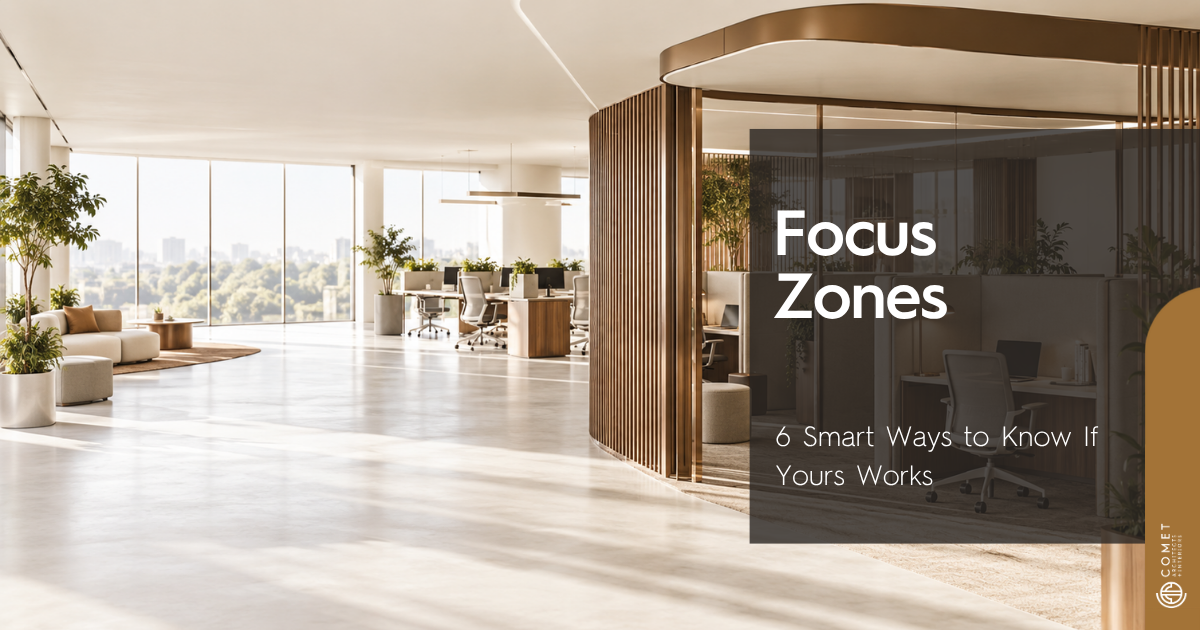
Measuring Whether a Focus Zone Is Doing Its Job
Table of Contents
Focus zones get built with conviction and evaluated almost never. The area is designated, screened, furnished with better chairs and softer lighting, and then handed over. Whether it works becomes a matter of anecdote — someone says it is great, someone else says nobody uses it, and both are treated as equally valid because no one measured anything.
When measurement does happen, it usually makes things worse. The metric reached for first is occupancy, and occupancy is the wrong measure for a focus zone. It answers a question about furniture efficiency when the question that matters is whether a particular kind of work became possible.
A focus zone is not a space allocation. It is a claim about behaviour: that a certain type of work will happen here that could not happen elsewhere. Testing that claim requires different evidence.
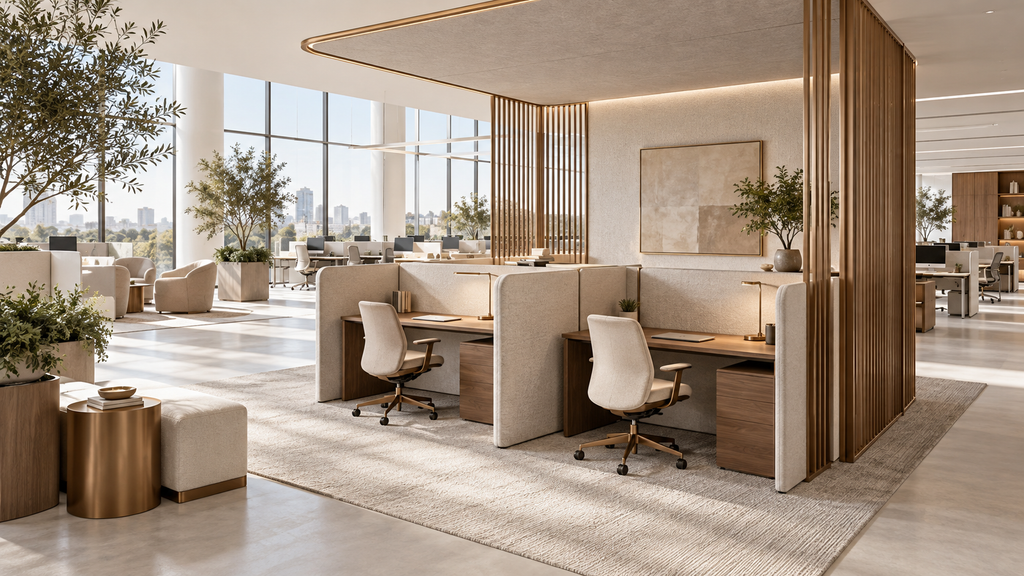
Why Occupancy Is the Wrong Measure
Occupancy tells you how many seats were filled. It cannot tell you whether the work being done in them was the work the zone was built for.
A focus zone running at 85 per cent occupancy looks like a success and may be a failure. If people are using it as overflow desking because the main floor is full, the zone has been converted into general workspace and the focus function has quietly disappeared — while the dashboard reports it as the best-performing area on the floor.
The inverse is equally misleading. A zone at 20 per cent occupancy looks like wasted space and may be working exactly as intended. Focus work is intermittent for most roles. A zone that is empty for much of the week but reliably available and effective when someone needs three uninterrupted hours is doing its job. Judged on occupancy, it gets value-engineered out of the next fit-out.
This is the core problem with importing utilization thinking into focus zones. JLL’s occupancy research is genuinely useful for sizing a floor plate and for understanding aggregate demand. Applied to a space whose value lies in availability rather than throughput, it produces the wrong conclusion in both directions.
What “Doing Its Job” Actually Means
Before measuring, the claim has to be stated precisely enough to be testable. Most focus zone briefs are not.
“Somewhere quiet to concentrate” is not a testable claim. It has no duration, no task type, no user group, and no comparison. A testable version reads more like: knowledge workers in the analysis and finance teams will complete sustained individual work in sessions of ninety minutes or more, without interruption, at least twice a week, in this zone rather than at home or in a booked meeting room.
That version can be checked. It names who, what kind of work, how long, how often, and — critically — what it is replacing. The last part matters most, because a focus zone always competes with alternatives: the main desk, a meeting room used as a hiding place, a café, or home.
Leesman’s workplace research consistently finds that the ability to concentrate is among the activities workplaces support worst, and that failure rarely announces itself. People adapt around it. A focus zone that fails does not generate complaints; it generates absence.
Four Signals That Actually Work
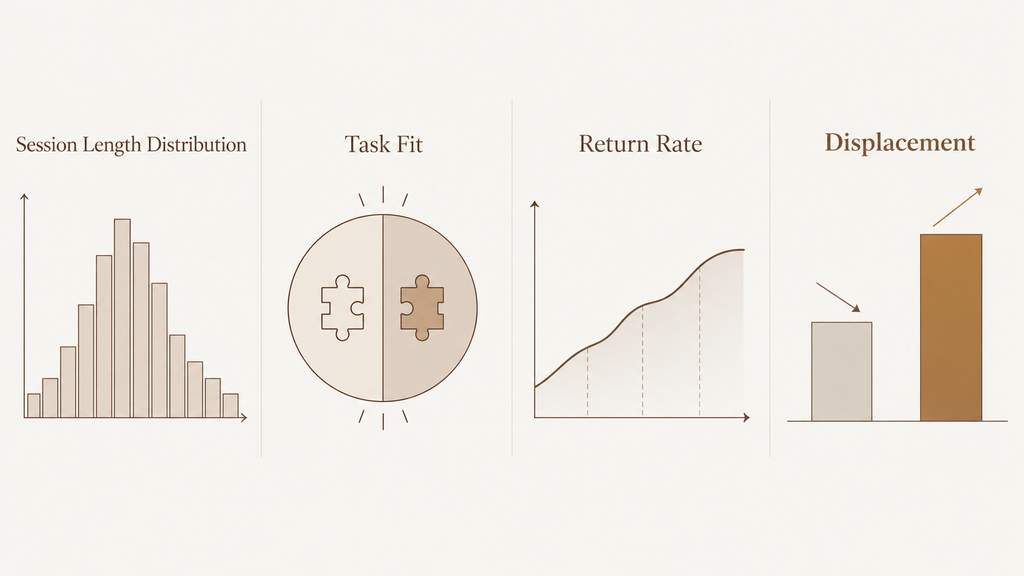
Four measures, taken together, give a reliable picture. None of them is occupancy.
Session length. The distribution matters more than the average. A focus zone whose sessions cluster around twenty minutes is functioning as a phone booth or a quick-escape space, not as a deep work environment, regardless of how busy it looks. Sessions of ninety minutes and above are the signal that sustained work is actually happening.
Task fit. What are people doing in there? This requires asking, not sensing. A short intercept question — what were you working on, could you have done it at your desk — separates a zone supporting concentration from one absorbing overflow.
Return rate. Do the same people come back? A focus zone that works produces habitual users. A zone that is tried once by many people and re-used by few has failed a test that no occupancy figure will reveal, because the raw visit count can look healthy throughout.
Displacement. Where did this work happen before, and where does it happen now? If the zone is working, something else should have reduced — meeting rooms booked by individuals, home-working days taken specifically to concentrate, or headphone use at desks. If nothing decreased, the zone added capacity without changing behaviour.
Displacement is the strongest single indicator and the least commonly measured, because it requires having looked at the situation before the zone existed.
What Sensors Cannot Tell You
Occupancy sensors are cheap, unobtrusive and increasingly standard. They are also blind to everything that distinguishes a working focus zone from a failing one.
A sensor registers presence. It does not register whether the person was concentrating, interrupted, or simply sitting somewhere quieter than their desk while doing email. It cannot tell whether they chose the zone or settled for it. It cannot detect the person who tried it twice, found it unusable, and now works from home on Thursdays instead — which is the most important data point available and appears nowhere in the system.
This is the same limitation that applies across workplace measurement and post occupancy evaluation generally: instrumentation describes conditions accurately and interprets them not at all. The practical answer is to pair sensor data with a small amount of direct enquiry. Twenty short conversations over two weeks will explain a pattern that a year of sensor data only describes. Comet’s approach to technology planned into the workplace from the start treats sensing as one input among several rather than as the evidence base.
False Positives and False Negatives
Two failure modes recur, and both are produced by measuring the wrong thing.
The busy zone that fails. High occupancy, short sessions, low return rate, no displacement elsewhere. This is a focus zone that has become general seating. It reports well and delivers nothing, and it usually gets expanded — which makes the problem larger.
The quiet zone that works. Low occupancy, long sessions, high return rate among a defined group, and measurable displacement from meeting rooms or home. This zone is doing precisely what it was built to do for the people who need it, and it is the one most likely to be removed in a space-efficiency review.
Distinguishing these two takes four numbers and twenty conversations. Failing to distinguish them means the organisation systematically expands the spaces that do not work and removes the ones that do.
The Baseline Problem
Almost every evaluation of a focus zone runs into the same wall: there is nothing to compare against.
Displacement cannot be measured without knowing what the pattern was before. Return rate has no meaning without knowing how many people had the need in the first place. Session length can be measured after the fact, but whether ninety minutes represents an improvement depends on what people managed previously.
The practical consequence is that workplace measurement belongs to the design stage, not to the post occupancy stage. Before a focus zone is built, three things should be recorded: how often people currently work from home specifically to concentrate, how often individuals book meeting rooms for solo work, and what proportion of the target group reports being unable to complete sustained work in the office.
None of this is difficult. All of it is impossible to reconstruct afterwards. Organisations building hybrid office design around occupancy data already have most of the collection mechanisms in place — the gap is usually that nobody thought to capture the focus-specific questions before handover.
When to Measure
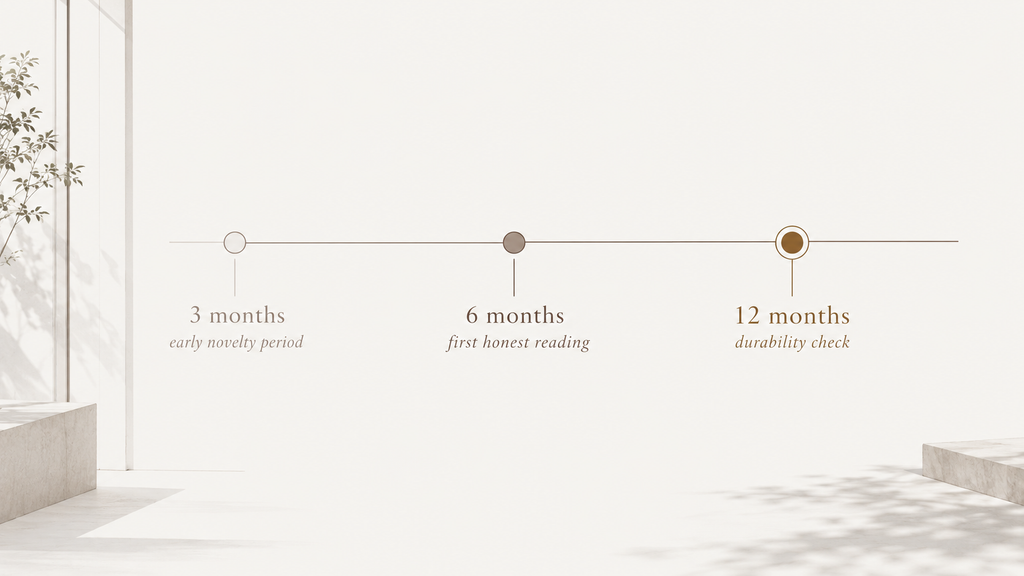
Timing changes what the data means, and three points are worth distinguishing.
Weeks one to four produce novelty data. Usage is inflated by curiosity, and patterns have not settled. Measuring here and declaring success is a common error.
Months three to four give the first honest reading. Novelty has worn off, habits have formed or failed to form, and the return-rate signal becomes meaningful.
Month twelve tests durability, and it is the one most often skipped. It answers whether the zone survived a year of organisational change, headcount growth and pressure on space — or whether it was quietly annexed for desks in month eight and nobody recorded the decision.
Reporting It So the Result Survives
Getting the measurement right is only half the work. The other half is presenting it in a form that holds up in a room where space is contested.
Four numbers and a paragraph is the right size. A focus zone report that runs to twenty slides will not be read, and one that reports only occupancy will be used against the zone. The useful format states the original claim, gives the four signals against it, and ends with a single recommendation — keep, adjust, or convert.
Two presentation choices matter more than they should. First, report displacement in the same units as the cost of the space. If the zone removed forty solo meeting room bookings a month, that is forty hours of room capacity returned to the business, and it belongs next to the square metres the zone occupies. Second, name the user group by size rather than by department. “Twenty-two people rely on this weekly” is harder to argue with than “the finance team uses it”.
Post occupancy evaluation of any kind tends to fail at this point rather than at the data-gathering stage. The evidence exists, it is accurate, and it never reaches the person making the decision in a form they can act on. Workplace measurement is only worth doing if the reporting is designed alongside it.
The same principle runs through Comet’s interior design thinking: the decision and the evidence for it are one piece of work, and both need an audience.
The Egyptian and Regional Context
Focus zones face specific pressures in Egypt that global guidance does not anticipate.
Density expectations in Cairo offices are generally higher than in Western benchmarks, and space is allocated conservatively. A zone that appears underused is under immediate competitive pressure from teams that need desks, which means the measurement case for keeping it has to be made faster and more explicitly than it would elsewhere. A focus zone in an Egyptian office rarely gets three years to prove itself.
Working patterns compound this. In-person attendance across Egyptian corporates remains high relative to European hybrid norms — the pattern reflected in Gensler’s global workplace research does not transfer directly. Sustained full occupancy means focus zones are under constant pressure to absorb overflow, which is precisely the failure mode that occupancy metrics disguise.
There is also an acoustic dimension. Many Cairo commercial buildings have deep floor plates, hard finishes and significant street noise, so the baseline acoustic environment is more demanding than the standards assumed in most workplace research. A focus zone that would perform adequately in a quieter building may need genuine acoustic separation here to deliver the same result — and if it was built without that, measurement will show it failing for reasons the brief never addressed.
Across the wider Gulf the pattern is similar but less acute, with more generous floor plates and newer building stock reducing the acoustic burden.
Who Should Be in the Room
Measurement design needs four parties, and the composition determines whether the results get acted on.
The workplace or HR lead, who can define the target group and the type of work being protected, and who has access to the people whose behaviour is being measured.
The design team, because the measures need to test what the zone was actually designed to do rather than a generic notion of focus, and because the design intent is where the testable claim comes from.
Facilities, who will observe the zone daily and who will be the first to know when it starts absorbing overflow.
Whoever controls space allocation, and this is the one usually left out. If the person who can convert the zone to desks is not part of agreeing what success looks like, the measurement has no protective value — the zone will be reallocated on an occupancy figure regardless of what the other evidence says.
The wider body of Comet’s workplace thinking treats this as a governance question as much as a research one. Evidence that nobody agreed to in advance does not change decisions.
A Measurement Checklist
Seven questions to settle before a focus zone is built, not after:
- Which specific group is this zone for, and what kind of work are we protecting?
- What session length would constitute success — and what would indicate failure?
- Where is this work happening now, and how will we know it moved?
- What baseline are we capturing before handover?
- How will we ask about task fit, and who will do the asking?
- At what points will we review — and is month twelve in the plan?
- Who can reallocate this space, and have they agreed to these measures?
If question seven has no answer, the zone will eventually be judged on occupancy — because that is the number that is always available.
One Question That Cuts Through
If all the workplace measurement in the world were unavailable, one question would still get most of the way there: ask the target group where they went, last time they had three hours of work that needed uninterrupted attention. If the focus zone is not in most of the answers, no dashboard is going to redeem it.

Measuring the Claim, Not the Seats
A focus zone is one of the few workplace investments whose success is invisible in the metrics most organisations collect. It is used intermittently by design, it competes with alternatives that leave no trace, and its failure produces absence rather than complaint.
That combination makes it unusually vulnerable. Not because it does not work, but because the standard evidence base cannot show that it does.
Measuring it properly is not expensive. It requires stating the claim precisely, capturing a small baseline before handover, tracking four signals rather than one, and agreeing in advance with the person who could take the space away. This is the same discipline that makes office design a business strategy rather than a visual upgrade — the design decision and the evidence for it are the same piece of work.
Talk to Comet about your workplace →
Frequently Asked Questions
How do you measure whether a focus zone is working?
Not by occupancy. Four signals give a reliable picture: session length distribution, task fit gathered by short direct questions, return rate among a defined user group, and displacement — whether solo meeting room bookings or concentrate-at-home days reduced after the zone opened. Displacement is the strongest indicator and requires a baseline captured before handover.
Why is occupancy a poor metric for focus zones?
Because it measures seat use rather than work type. A busy focus zone may have become overflow desking, which reports as success while the focus function has disappeared. A quiet one may be working exactly as intended, since focus work is intermittent and the zone’s value lies in reliable availability rather than throughput.
When should a focus zone be evaluated?
Months three to four for the first honest reading, once novelty has worn off and habits have formed. Month twelve tests durability and is the review most often skipped — it reveals whether the zone survived a year of pressure on space or was quietly converted to desks.
What baseline data should be captured before building a focus zone?
How often people currently work from home specifically to concentrate, how often individuals book meeting rooms for solo work, and what proportion of the target group reports being unable to complete sustained work in the office. None is difficult to collect; all are impossible to reconstruct afterwards.
Who should be involved in measuring a focus zone?
The workplace or HR lead, the design team, facilities, and — critically — whoever controls space allocation. If the person able to convert the zone to desks has not agreed what success looks like, the measurement offers no protection. Related reading on spatial strategies that protect deep focus and designing for a multi-generational workforce.