
Office Interior Design: Why Intelligence Beats Technology in Future Offices
Table of Contents
Every workplace technology pitch makes the same implicit promise: install this, and the office will work better. Sensors will reveal how space is used. Booking systems will solve meeting room scarcity. Adaptive lighting will improve wellbeing. Dashboards will make everything measurable.
The technology usually does what it claims. The office interior design around it frequently does not improve anything.
This is the uncomfortable finding sitting underneath a decade of workplace investment, and it has a specific cause. Technology reports what is happening. It does not interpret why, and it cannot decide what to do about it. That interpretive work is what separates office interior design that changes how an organisation performs from workplace design that simply modernises its appearance.
The Evidence That Building Something New Is Not Enough
The most useful research here is uncomfortable for the industry that produces it.
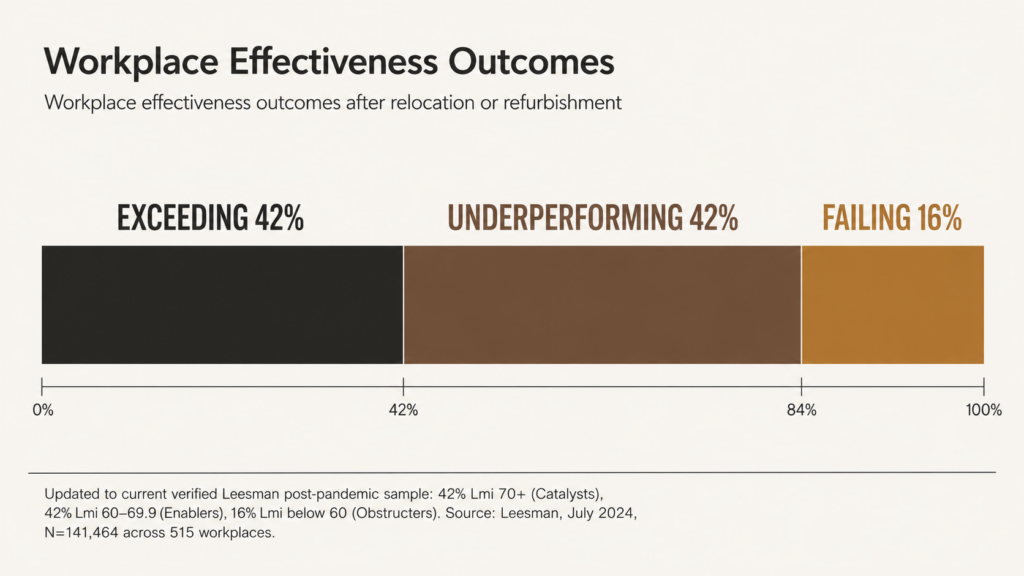
Leesman’s assessment of workplaces after relocation or refurbishment found that while 41 percent of new workplaces deliver an exceptional employee experience, 40 percent fail to reach their potential and 19 percent are actively failing their occupants. Roughly six in ten organisations spent significant capital and did not get what they paid for.
The explanation Leesman offers is precise. Physical workplace improvements alone cannot address modern organisational requirements — without carefully considering human behavioural dynamics and connecting them to a design strategy, a fundamental disconnect persists between the physical infrastructure and how people actually work.
Read that carefully, because it is the whole argument. The failure is not insufficient investment or inadequate specification. It is a missing link between what was built and how the organisation behaves.
Behaviour Does Not Change Because You Built Something
The clearest demonstration comes from activity-based working, an idea that is intellectually sound and frequently fails in practice.
Leesman studied 11,336 employees across 40 activity-based workplaces — environments offering a range of settings so people can choose the space that suits each task. The finding was that these employees rarely worked in an activity-based way. People do not change the working habits of a lifetime because their employer tells them to.
The settings existed. The technology to find and book them existed. The behaviour did not follow.
This should be the founding observation of any serious approach to workplace change. Space does not instruct people. It creates conditions in which certain behaviours become easier or harder, and the organisation’s existing culture determines what actually happens within those conditions. A design that ignores current behaviour is not ambitious — it is simply guessing, and the research suggests it guesses wrong most of the time.
Comet’s position on this is longstanding: office design is a business strategy rather than a visual upgrade, and the strategic part is understanding the organisation, not selecting the specification.
What Design Intelligence Actually Means
The phrase risks sounding like marketing, so it is worth defining concretely. Design intelligence is the capacity to read an organisation accurately and translate what you find into spatial decisions. It has four practical components.
Together they form the basis of any workplace strategy worth the name.
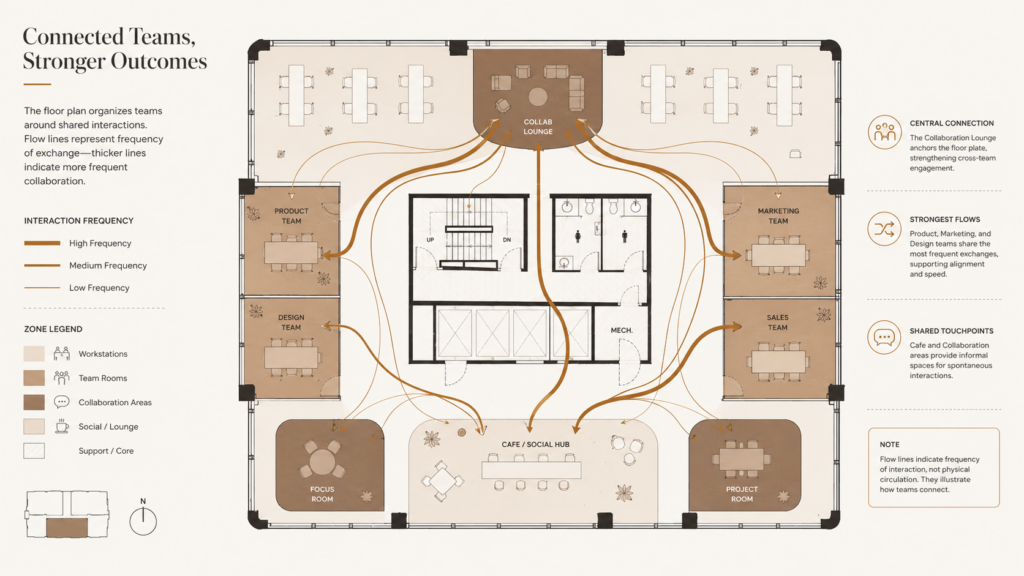
Reading how work actually moves. Not the org chart, but the real flow — which teams exchange information hourly, which conversations happen informally, where decisions genuinely get made rather than where they are formally ratified.
Distinguishing stated culture from observed culture. Most organisations describe themselves as collaborative. Some are. The evidence is in behaviour, not in the values statement, and designing for the stated version produces spaces nobody uses.
Understanding constraint tolerance. Every organisation has limits on how much change it can absorb at once. Exceeding that tolerance produces resistance that gets misattributed to the design.
Knowing what not to solve. Some problems described as spatial are managerial. A meeting room shortage is sometimes a booking behaviour problem, not a supply problem, and building more rooms rewards the behaviour instead of correcting it.
None of these can be measured by a sensor. All of them determine whether the resulting office interior design works, and all of them belong in the workplace strategy before a single drawing is produced.
Where Technology Genuinely Helps
The argument here is about sequence and hierarchy, not about rejecting technology.
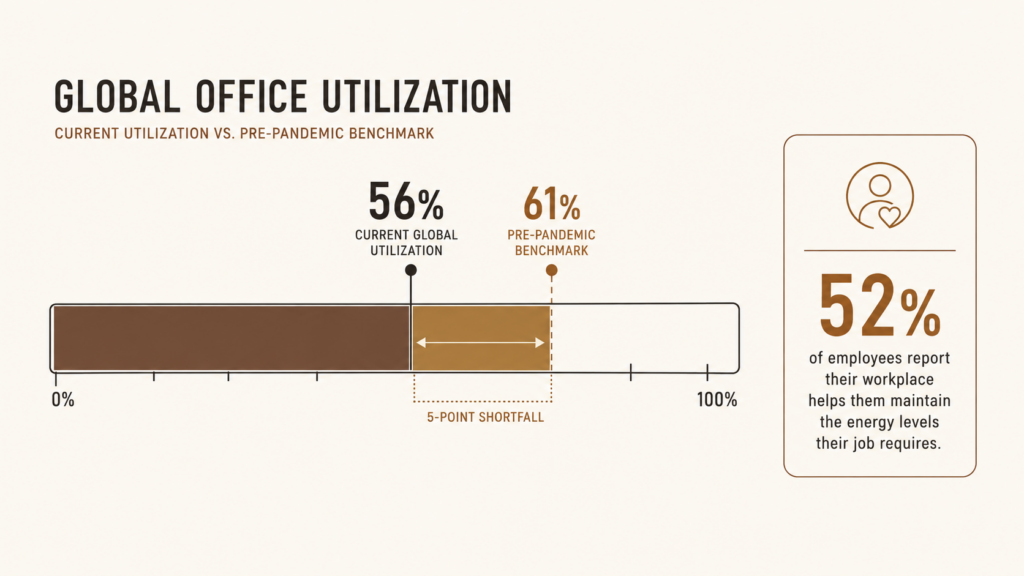
Utilization data is genuinely valuable. It reveals the gap between assumed and actual demand, and that gap is consistently large: JLL’s global occupancy research puts office utilization at 56 percent in 2026, against a pre-pandemic benchmark of 61 percent. No amount of design intuition produces that figure. Measurement does.
Environmental systems that respond to real conditions outperform fixed settings. Booking platforms that show genuine availability reduce friction, and they belong in the workplace design brief from the outset. Building management systems that flag underperforming zones catch problems earlier than complaints do.
The pattern is consistent. Technology is excellent at description and poor at judgement. It tells you a zone is empty. It cannot tell you whether that is because the space is badly located, poorly lit, socially claimed by one team, acoustically exposed, or simply new — and those five explanations lead to five different interventions.
Comet’s approach to technology planned into the workplace from the start treats systems as instrumentation for a design decision, not as the decision itself.
The Failure Mode: Technology as a Substitute for Thinking
The pattern repeats often enough to be predictable.
An organisation recognises its workplace is underperforming. Rather than investigate why, it procures a solution — occupancy sensors, a workplace app, a smart building package. The technology is deployed competently. Dashboards populate. Reports circulate.
And nothing changes, because no decision followed the data. The dashboards describe the same problems in higher resolution.
This happens because technology procurement is easier than organisational diagnosis. It has a defined scope, a vendor who takes responsibility, and a visible deliverable. Diagnosis is ambiguous, requires access to uncomfortable truths about how the organisation actually functions, and produces findings that may implicate management rather than the floor plan.
The result is an office interior design that is thoroughly measured and largely unchanged.
When Design Follows Fashion Instead of Evidence
There is a recognisable cycle in commercial interior design, and most organisations have been through at least one turn of it.
A workplace idea gains momentum — open plan, then hot desking, then activity-based working, then the resimercial aesthetic, then the hospitality-influenced office. Each arrives with case studies from organisations where it genuinely worked, and each gets adopted widely by organisations that resemble those cases in almost no respect.
The mechanism is straightforward. Office design trends spread through published images rather than through published outcomes. A photograph communicates the aesthetic instantly and communicates nothing about whether the space supported the business. So the visible layer travels and the reasoning stays behind.
This is why so much workplace design converges on a similar look while producing wildly different results. Two offices can share the same palette, the same furniture language and the same zoning vocabulary, and one will support its organisation while the other quietly obstructs it. The difference was never in the specification.
A sound workplace strategy protects against this by requiring a reason for each decision that refers to the organisation rather than to a precedent. The test is simple: if the justification for a design move is that other companies are doing it, the move has not been justified. If the justification is that this organisation’s teams behave in a particular way and this arrangement supports that behaviour, it has.
None of this is an argument against ambition or against aesthetic quality. Comet’s work on the commercial interior design trends shaping the market exists precisely because trends carry real ideas worth understanding. The discipline is in deciding which of them apply here, to this organisation, for reasons that can be stated out loud.
Designing for How Decisions Actually Get Made
One dimension of organisational reality is almost never designed for explicitly, and it matters more than most spatial decisions.
Every company has an actual decision-making pattern that differs from its stated one. Some run on scheduled meetings. Some run on informal proximity — decisions made in corridors and at desks, ratified later in meetings. Some are heavily centralised around one or two people whose availability determines everything.
These patterns have direct consequences for workplace design. An organisation that decides informally needs proximity and visibility between the right people, and it suffers badly from distributed floor plans. An organisation that decides in scheduled forums needs reliable meeting supply and suffers from room scarcity. An organisation centralised around a founder needs that person accessible without making access performative.
Office interior design that delivers a collaborative open plan to a company which actually decides in closed sessions produces a space that photographs well and obstructs the business. This is precisely the translation work that no technology performs — and where spatial strategies that protect deep focus either succeed or fail depending on whether they matched the organisation’s real rhythm.
Why Best Practice Needs Translation
Workplace research is genuinely useful and routinely misapplied.
Benchmarks describe averages across large samples. Leesman’s wellbeing research shows the average workplace experience score rising from 64.3 before the pandemic to 69.5 across 2022 to 2025, yet only 52 percent of employees say their workplace helps them maintain the energy levels their job requires. Both figures are true simultaneously — improvement in aggregate, persistent failure in a specific dimension.
An organisation adopting a benchmark without asking whether its own situation resembles the sample is importing someone else’s answer to someone else’s question. Desk ratios derived from Northern European hybrid patterns do not transfer cleanly to Gulf offices with higher in-person attendance. Collaboration space proportions from technology firms do not suit professional services practices with confidentiality requirements.
Best practice is a starting hypothesis. Design intelligence is the discipline of testing it against the specific organisation before committing capital to it — which is also why designing for a multi-generational workforce resists a single template.
Office Interior Design in the MENA Context
The regional dimension makes translation more important, not less.
Attendance patterns across the Gulf have generally settled at higher in-person levels than the European or North American benchmarks used in Gensler’s global workplace research assume, which changes desk provision, meeting supply and circulation loading. Applying a Western hybrid ratio to a Riyadh or Dubai office frequently under-provides.
Hierarchy and formality operate differently across regional organisations, and commercial interior design has to account for that. Office allocation, meeting room formality, and reception treatment carry meaning that a globally standardised design language can miscommunicate. A layout that reads as refreshingly egalitarian in one market can read as a downgrade in another.
Multinational organisations face this most directly, inheriting global commercial interior design standards written elsewhere. The intelligent approach is not to reject them, but to identify which elements are genuinely universal and which were local answers that travelled without being re-examined.
The Comet Approach
Comet treats the diagnostic phase as the substance of the work rather than as preliminary.
That means understanding how the organisation actually operates before proposing what it should occupy: how work moves between teams, where decisions are made, what the culture does rather than what it claims, and how much change the organisation can absorb. Measurement supports this workplace strategy — utilization data, booking patterns, structured observation — but it informs the interpretation rather than replacing it.
Technology then gets specified for what it is genuinely good at: describing conditions, reducing friction, and giving the organisation a way to check whether the design performed. The full range of Comet’s interior design thinking rests on that order — understand, then decide, then instrument.
Seven Questions That Test Design Intelligence
Worth asking any design partner before appointing them:
- What will you do to understand how our organisation actually works, before proposing anything?
- How will you tell the difference between our stated culture and our observed culture?
- Which of the problems we have described do you think are not spatial?
- What benchmarks will you use, and why do you believe they apply to us?
- How much change do you think we can absorb, and what happens if we exceed that?
- What technology are you recommending, and what specific decision will it inform?
- How will we know in twelve months whether this worked?
A partner who answers these in terms of specification and finishes is selling commercial interior design as a product. One who answers in terms of your organisation is offering it as judgement.
A Note on Sequence
The order matters more than any individual choice. Diagnosis, then design, then instrumentation. Organisations that reverse it — buying systems first and hoping insight follows — end up with excellent data about a workplace design nobody examined. The sequence is the strategy.

Intelligence First, Instruments Second
The most successful future workplaces will not be the most technologically equipped. They will be the ones where someone did the harder work of understanding the organisation before deciding what to build. That is what separates office interior design from decoration.
Technology has made workplaces more measurable than at any point in their history. It has not made the underlying question easier: what does this specific organisation, with this specific culture, doing this specific work, actually need from its space?
That question is answered by judgement informed by evidence — which is what design intelligence means, and why it will continue to matter more than whatever gets installed on top of it.
Talk to Comet about your workplace →
Frequently Asked Questions
Does workplace technology improve office performance?
It improves visibility, not performance directly. Sensors, booking systems and building management platforms describe what is happening accurately. They do not interpret why, and they cannot decide what to change. Leesman’s research found that a majority of new workplaces fail to deliver their intended experience despite substantial investment — the gap is interpretive, not technological.
What is design intelligence in office interior design?
The capacity to read an organisation accurately and translate that understanding into spatial decisions. In practice it means mapping how work actually moves, distinguishing stated culture from observed behaviour, judging how much change the organisation can absorb, and recognising which problems are managerial rather than spatial.
Why do activity-based workplaces often fail?
Because providing settings does not change behaviour. Leesman found that employees in activity-based workplaces rarely worked in an activity-based way — people do not abandon long-established habits because a new environment invites them to. Successful implementations design from existing behaviour rather than against it.
Can global workplace benchmarks be applied in MENA offices?
Only after translation. Gulf attendance patterns are generally higher in person than the Western hybrid datasets most benchmarks derive from, so desk ratios and meeting provision imported directly tend to under-provide. Benchmarks are a starting hypothesis to be tested locally, not an answer.
When should technology be specified in a workplace project?
After the design questions are settled, not before. Technology should be selected to inform a specific decision or reduce a specific friction the diagnosis identified. Specifying systems first produces a well-measured workplace that behaves exactly as it did before.