
Why Retail Layout Is a Revenue Strategy — Not a Design Decision
Retail performance is often evaluated through pricing, product mix, and marketing.
But one of the most overlooked drivers of revenue sits right in front of customers every day:
The layout of the store.
Retail layout strategy is not about aesthetics, decoration, or visual appeal. It is about how space converts movement into revenue.
The way customers enter, move, pause, and purchase inside a store is directly influenced by spatial decisions. And those decisions—when done correctly—can increase sales per square meter, dwell time, and basket size without changing a single product.
This is why leading retail brands no longer treat layout as a design task.
They treat it as a business strategy.
The Real Problem: Most Retail Layouts Are Built Backwards
In many retail projects, layout decisions follow a familiar but flawed process:
- Fixtures are placed based on visual balance
- Categories are arranged by internal logic, not customer behavior
- Circulation paths are left undefined
- Checkout zones are treated as endpoints, not conversion engines
The result?
- Customers miss key products
- Movement becomes inconsistent
- Bottlenecks form during peak hours
- High-margin items are underexposed
This is what we call layout inefficiency—and it directly impacts revenue.
In high-performing retail environments, layout is not an afterthought.
It is engineered from day one to support how customers actually behave.
What Is a Retail Layout Strategy?
A retail layout strategy is the intentional planning of space to:
- Guide customer movement
- Control visibility and exposure
- Influence decision-making
- Maximize conversion opportunities
It connects physical design with business outcomes.
Instead of asking:
“How should this store look?”
The right question becomes:
“How should this store perform?”
How Retail Layout Impacts Revenue (With Measurable Outcomes)
When layout is approached strategically, it delivers measurable impact across key retail KPIs.
1. Sales per Square Meter
Optimized layouts typically drive:
- +8% to +15% increase in sales/m²
By:
- Improving product exposure
- Reducing dead zones
- Enhancing category adjacency
2. Dwell Time
Customers stay longer when movement feels natural and engaging:
- +10% to +20% increase in dwell time
Achieved through:
- Clear circulation paths
- Visual anchors
- Strategic pause points
3. Basket Size
Better flow leads to more discovery:
- +5% to +12% increase in average basket value
Driven by:
- Cross-merchandising
- Impulse placement
- Logical product grouping
4. Conversion Rate
Reducing friction improves decision-making:
- +6% to +10% increase in conversion
Enabled by:
- Clear sightlines
- Accessible product zones
- Efficient checkout design
The Core Principles of High-Performing Retail Layouts
To turn layout into a revenue strategy, five key principles must be applied.
1. Entry Decompression Zone
The first few steps inside a store are critical.
Customers need space to:
- Adjust to the environment
- Understand the store structure
- Orient themselves
Without this zone:
- Products near the entrance are ignored
- Customers feel rushed or disoriented
Strategic impact:
Improves first impressions and sets the tone for the entire journey.
2. Circulation Flow Engineering
Customer movement should never be random.
High-performing stores define:
- Primary pathways
- Secondary exploration zones
- Directional flow (guided, not forced)
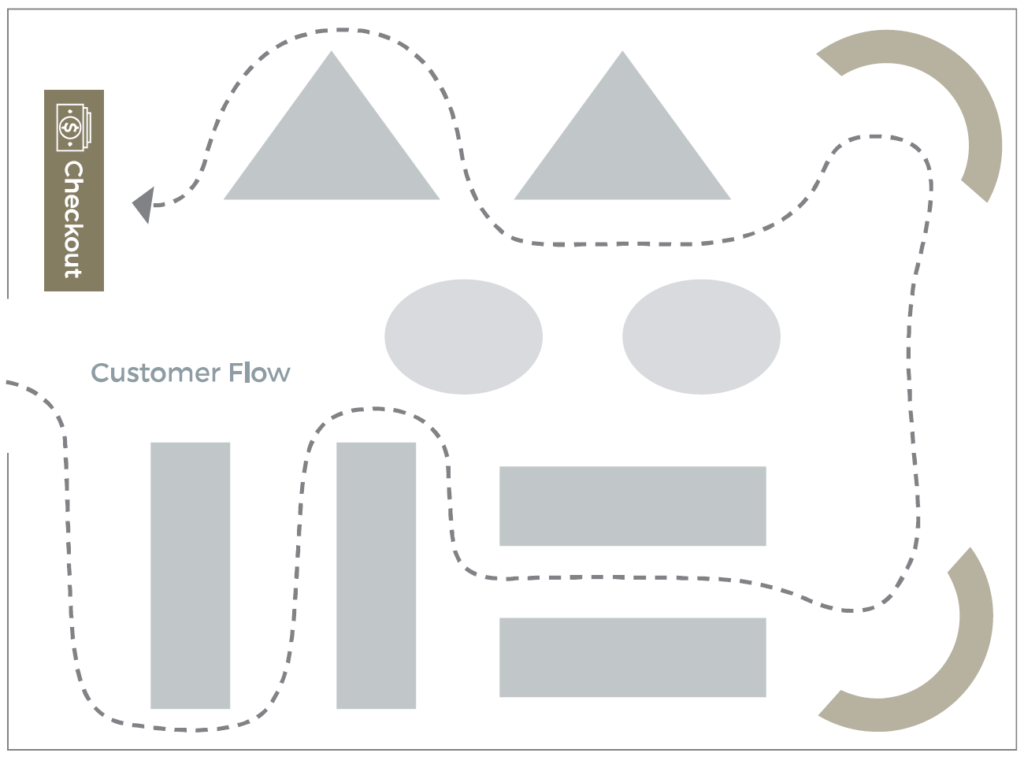
Common approaches include:
- Loop layouts
- Racetrack circulation
- Guided free-flow systems
Strategic impact:
Ensures every customer passes through high-value zones.
3. Sightlines That Sell
What customers see determines what they buy.
Effective layout strategy ensures:
- Key products are visible from multiple نقاط
- High-margin items are placed in dominant sightlines
- Depth views encourage movement deeper into the store
Strategic impact:
Increases product discovery without additional marketing spend.
4. Adjacency Logic
Products should not just be grouped—they should be connected.
For example:
- Complementary items placed together
- Sequential shopping journeys
- Cross-category visibility
Bad adjacency leads to:
- Missed upselling opportunities
- Fragmented customer experience
Strategic impact:
Drives basket size through natural purchasing behavior.
5. Checkout as a Conversion Zone
Checkout is not just a transaction point.
It is one of the highest-performing areas for:
- Impulse purchases
- Last-minute additions
Strategic checkout design includes:
- Queue visibility
- Small product displays
- Efficient flow to reduce abandonment
Strategic impact:
Maximizes revenue at the final stage of the journey.
The Hidden Cost of Poor Layout Decisions
When layout is treated as a visual exercise, the consequences are measurable.
Common Issues:
- Dead zones (low-traffic areas)
- Overcrowded aisles
- Inconsistent customer flow
- Long checkout queues
- Underperforming categories
Business Impact:
- Lower sales per square meter
- Reduced customer satisfaction
- Increased operational friction
- Missed revenue opportunities
In multi-branch retail environments, these problems multiply across locations—creating systemic revenue loss.
Layout Strategy in Multi-Branch Retail Expansion
For growing retail brands, layout strategy becomes even more critical.
It must balance:
- Standardization → consistent brand experience
- Adaptation → response to site constraints
A strong layout system allows brands to:
- Scale faster
- Maintain performance consistency
- Reduce design and execution errors
- Control costs across rollouts
This is where layout shifts from a design deliverable to a governance tool.
From Design to Performance: A Shift in Mindset
The most important shift is not technical—it is strategic.
Retail leaders must move from:
- “Designing stores”
To: - “Engineering performance environments”
This means:
- Layout decisions are based on data
- Space is measured by output, not appearance
- Every square meter has a defined role
Why This Matters for Retail Leaders in Egypt
In Egypt’s retail market, brands face:
- Increasing competition
- Rising operational costs
- Pressure to scale quickly
- Changing customer expectations
Under these conditions, layout becomes a lever for efficiency and growth.
A well-designed store can:
- Deliver higher revenue without increasing rent
- Improve customer experience without additional staff
- Support faster rollouts across new locations
Conclusion: Layout Is One of Your Strongest Revenue Drivers
Retail success is not only about what you sell.
It is about how customers experience the space where you sell it.
A strategic retail layout:
- Drives measurable revenue
- Improves customer flow
- Increases efficiency
- Supports scalable growth
And most importantly:
It turns your store into a high-performing business asset, not just a physical space.
Work With Comet
At Comet Architects + Interiors, we design retail environments with one goal:
Performance.
From layout strategy to technical documentation and rollout support, we help retail brands:
- Increase sales per square meter
- Improve customer flow
- Deliver consistent multi-branch performance
Ready to turn your retail space into a high-performing revenue driver?
Visit cometarch.com to explore our approach to retail layout strategy and store performance.
Contact us to discover how smart layout decisions can increase sales per square meter and improve customer flow.