
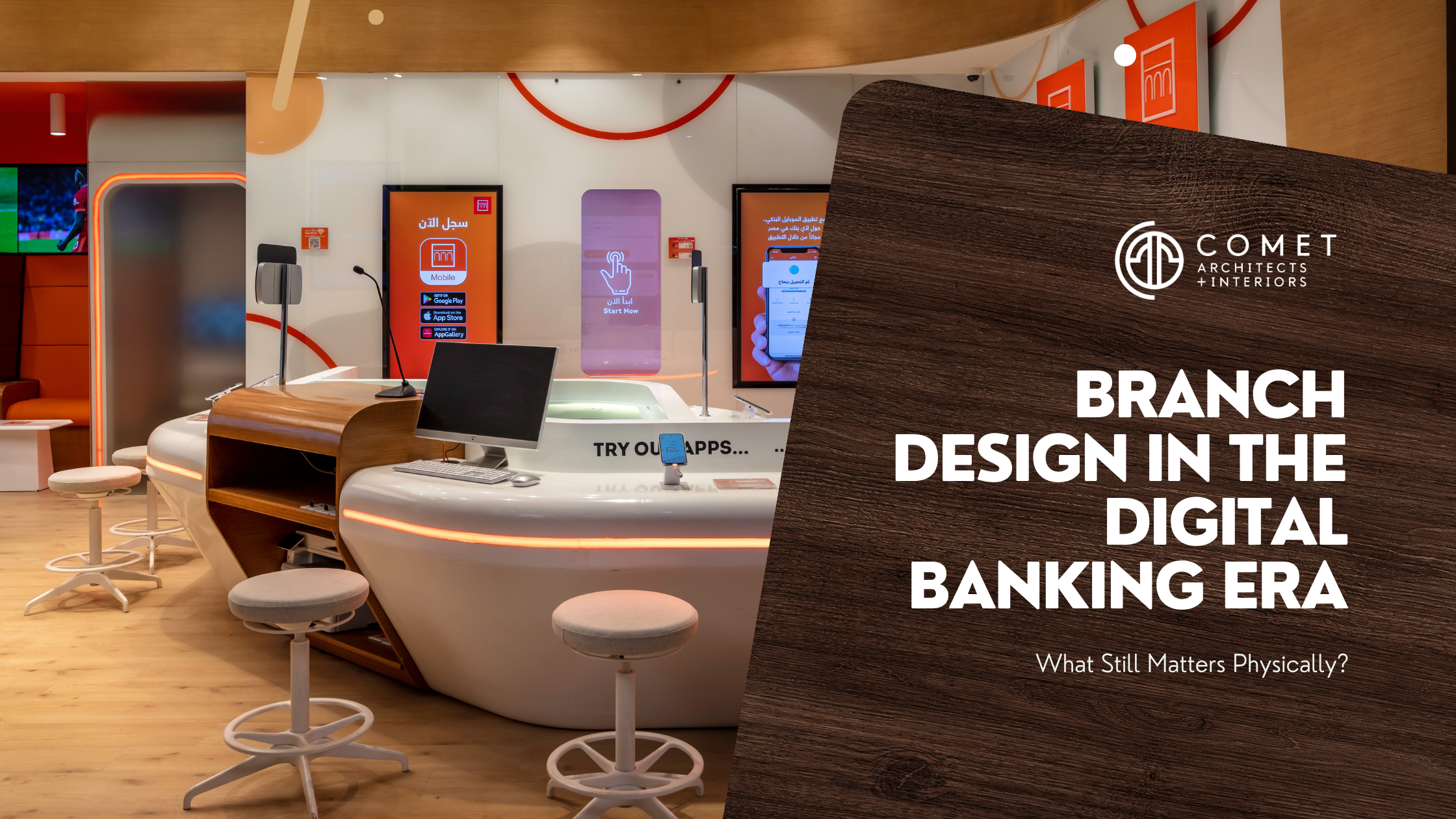
Branch Design in the Digital Banking Era: What Still Matters Physically?
Banking has changed dramatically over the last decade.
Transactions that once required a physical visit now happen instantly through mobile apps. Account openings, transfers, bill payments, and customer support increasingly operate through digital platforms rather than traditional counters.
As digital banking continues expanding, one question keeps emerging across the industry:
Do physical bank branches still matter?
The answer is yes—but not for the same reasons they mattered before.
Branches are no longer defined primarily by transaction volume. Their role has shifted toward something more strategic:
- Building trust
- Supporting customer relationships
- Reinforcing brand positioning
- Delivering complex services
- Creating physical reassurance in an increasingly digital ecosystem
This transformation has fundamentally changed how branch design should be.
Modern banking branches are no longer operational halls filled with repetitive service desks. They are now experience environments where space, movement, privacy, and technology integration directly shape how customers perceive the institution itself.
The Shift from Transactional Banking to Experiential Banking
Traditional bank branches were built around efficiency.
The objective was simple:
- Process transactions quickly
- Manage queues
- Handle large customer volumes
This created environments dominated by:
- Teller counters
- Waiting zones
- Linear circulation
- Administrative layouts
But digital banking has absorbed much of that operational load.
Today, routine transactions increasingly happen before the customer even enters the branch. As a result, physical spaces are no longer competing on transaction speed alone.
Instead, they compete on:
- Experience
- Trust
- Accessibility
- Human interaction
This changes the role of branch design completely.
The modern branch must support moments that digital platforms cannot fully replace:
- Financial consultation
- Relationship building
- Problem resolution
- High-value advisory services
- Brand reassurance
The physical environment now becomes part of the service itself.
Why Physical Branches Still Matter
Despite rapid digital adoption, physical branches continue to influence customer confidence significantly.
This is particularly important in sectors such as:
- Corporate banking
- Investment services
- Financing and lending
- Wealth management
Customers may use digital platforms daily, but they still associate physical presence with legitimacy and stability.
Research across banking environments consistently shows that customers are more likely to trust institutions with strong physical representation, particularly when handling complex or high-value financial decisions.
This is because physical branches provide something digital platforms cannot fully replicate:
human reassurance.
The branch acts as a tangible expression of the brand.
Its design communicates:
- Credibility
- Security
- Professionalism
- Transparency
And these perceptions directly affect customer behavior.
How Digital Banking Changed Branch Design Priorities
As operational dependency on branches decreases, design priorities shift toward experience quality rather than transaction density.
Modern branch environments now focus more heavily on:
- Spatial openness
- Privacy balance
- Customer flow
- Technology integration
- Emotional comfort
This represents a major departure from traditional banking layouts.
Branches are becoming:
- Smaller
- More flexible
- More hospitality-driven
- More consultation-focused
The environment itself must feel less administrative and more approachable.
Privacy Still Matters—But Differently
One of the biggest misconceptions in digital banking is assuming that privacy is becoming less important because services are moving online.
In reality, privacy remains critical—but its spatial expression has changed.
Traditional branches treated privacy through isolation:
- Closed offices
- Physical barriers
- Heavy partitions
Modern banking environments approach privacy more subtly.
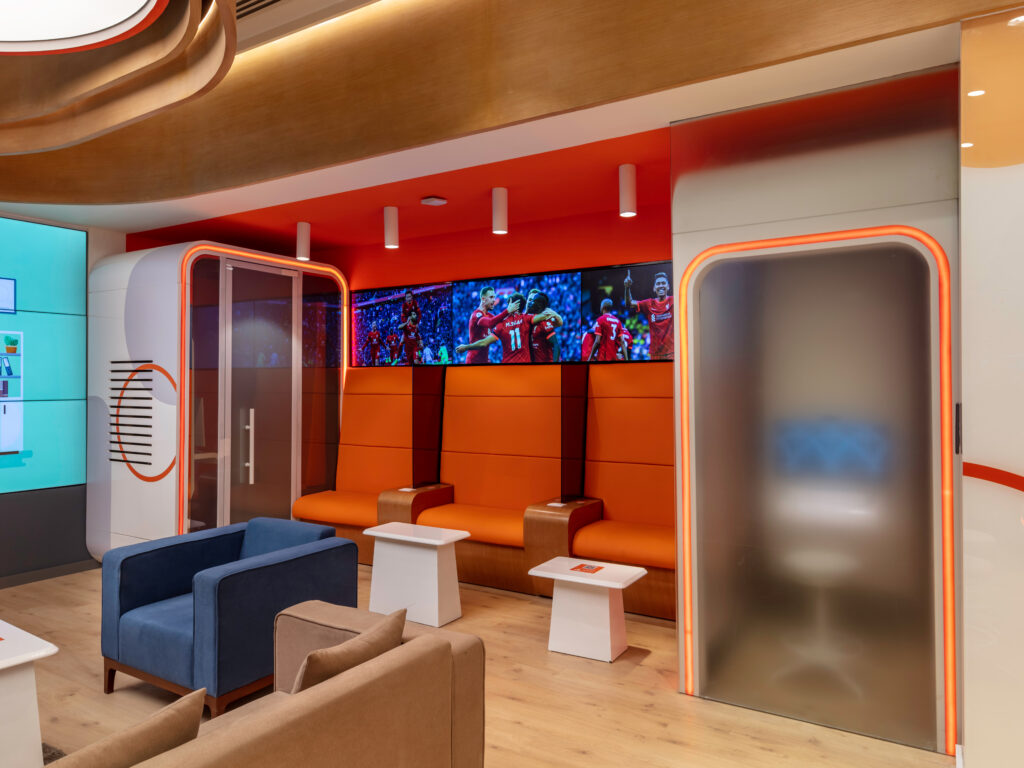
Customers still need discretion, especially during:
- Financial discussions
- Loan consultations
- Identity verification
- Business transactions
However, the space must now balance privacy with openness and accessibility.
This has led to:
- Semi-private consultation areas
- Acoustic control without visual heaviness
- Softer spatial transitions
- More hospitality-oriented meeting spaces
The goal is to create environments that feel secure without feeling intimidating.
The Role of Technology Inside Physical Branches
Digital banking has not eliminated the need for physical branches—it has changed how technology integrates within them.
Branches are increasingly becoming hybrid environments where digital and physical experiences operate together.
This includes:
- Self-service kiosks
- Digital onboarding stations
- Interactive service points
- Seamless mobile integration
The objective is not simply automation.
It is reducing friction.
Customers should move easily between digital and physical interactions without feeling disconnected between the two systems.
This requires careful spatial planning. Technology must feel integrated into the environment rather than inserted into it.
Poor integration often creates:
- Visual clutter
- Confusing circulation
- Queue conflicts
- Fragmented customer journeys
Strong branch design ensures that technology supports movement rather than interrupting it.
Customer Flow and Waiting Experience
Traditional banking branches often treated waiting as unavoidable.
Modern branch design treats waiting as part of the customer experience itself.
As transactional traffic decreases, customers visiting branches are usually seeking:
- Advice
- Consultation
- Resolution
- Human interaction
This changes expectations around comfort and movement.
Long rigid queue systems become less relevant, while:
- Lounge-style waiting areas
- Flexible seating
- Clear circulation
- Hospitality-inspired environments
become more important.
Studies across customer experience environments consistently show that perceived waiting time decreases significantly when environments feel comfortable and visually calm.
This directly affects customer satisfaction and brand perception.
Branch Design as Brand Positioning
In the digital banking era, branches are increasingly functioning as physical brand environments.
Customers may spend only limited time inside them, but those moments strongly influence perception.
Every spatial decision communicates something:
- Materials → stability and quality
- Lighting → openness and transparency
- Layout → accessibility and efficiency
- Spatial tone → institutional vs. human-centered
Banks competing in digital-first markets increasingly use physical branches to differentiate themselves emotionally rather than operationally.
This is why many modern banking environments now borrow design principles from:
- Hospitality
- Retail
- Corporate experience design
The objective is to make financial environments feel:
- More approachable
- More human
- More relationship-driven
without compromising professionalism or trust.
Why Human Interaction Still Defines Banking
Technology improves speed.
But trust is still largely built through people.
For complex financial decisions, customers continue seeking:
- Guidance
- Reassurance
- Expertise
- Conversation
This means physical environments must support meaningful interaction.
Poorly designed branches create:
- Stress
- Noise
- Lack of privacy
- Transaction-focused behavior
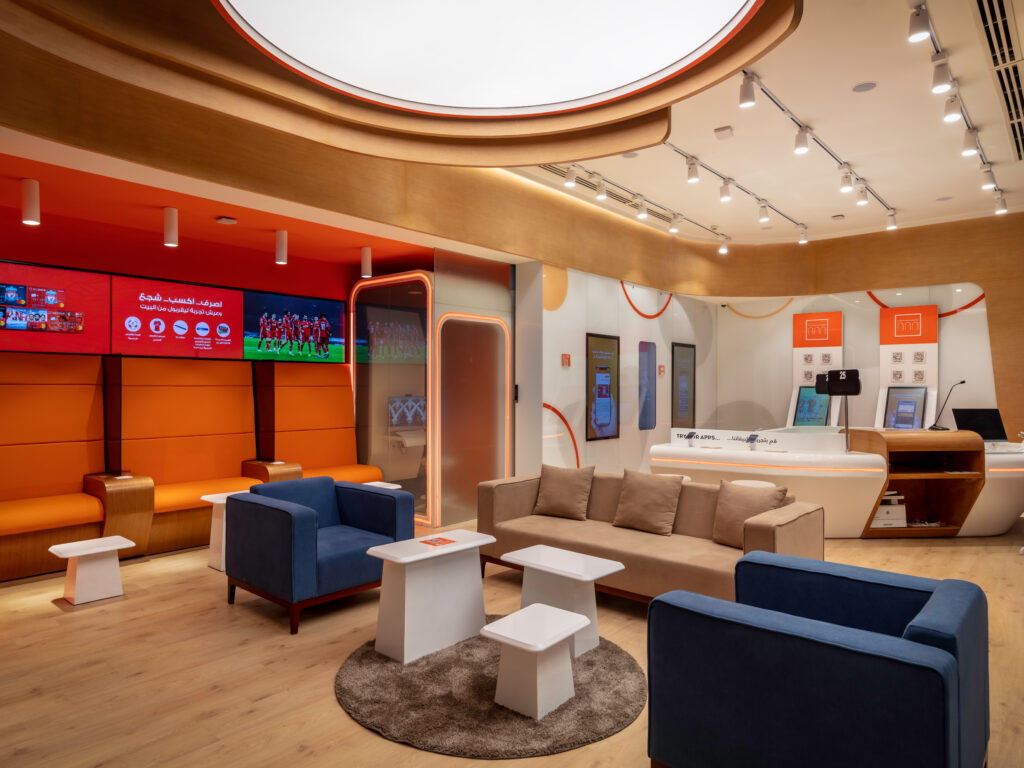
Well-designed branches create environments where conversations feel comfortable, calm, and focused.
This becomes especially important for:
- SME banking
- Corporate banking
- Wealth management
- Investment advisory services
In these areas, the branch remains strategically valuable.
The Future of Physical Banking Branches
Physical branches are not disappearing.
They are evolving.
The future branch will likely:
- Handle fewer routine transactions
- Focus more on advisory services
- Operate with smaller footprints
- Prioritize customer experience over density
This means branch design must evolve from:
operational efficiency
to:
experiential quality.
The strongest banking environments will not compete with digital platforms.
They will complement them.
Conclusion
Digital banking has changed how customers interact with financial institutions—but it has not eliminated the importance of physical space.
What still matters physically is no longer transaction processing alone.
It is:
- Trust
- Human interaction
- Comfort
- Privacy
- Brand perception
Modern branch design must support these experiences while integrating seamlessly with digital systems.
Because in the digital banking era, the physical branch is no longer just a service point.
It is a strategic experience environment that shapes how customers feel about the institution itself.
Banking environments are evolving from transactional spaces into customer experience platforms.
Visit cometarch.com to explore how strategic branch design supports trust, customer experience, and operational performance—or connect with our team to discuss your next banking project.